


Bitcoin has fallen back toward the $64,000 level after the Federal Reserve adopted a hawkish policy stance, erasing a relief rally that had been fueled by easing Middle East tensions and renewed hopes for lower energy prices.
Summary
- Bitcoin fell 4% from a June 17 high of $66,315 to an intraday low of $63,683 after the Fed’s hawkish outlook.
- Technical indicators show BTC testing key support near $64,000, with $62,000 and $60,000 as major downside levels.
- Analysts warn a failure to hold $64,000 could trigger another move toward the $61,000-$62,000 range.
According to crypto.news market data, Bitcoin (BTC) climbed to an intraday high of $66,315 on June 17 before reversing sharply following the Federal Reserve’s policy decision. The asset fell 4% to an intraday low of $63,683 during early June 18 trading before recovering slightly to around $64,444 at press time.
Bitcoin’s price dip followed after the Fed kept interest rates unchanged at 3.50%–3.75% and released a hawkish dot plot that projected fewer rate cuts and left the door open to future tightening. Selling pressure intensified further after Fed Chair Kevin Warsh signaled a move away from traditional forward guidance, injecting fresh uncertainty into the policy outlook and triggering a broad risk-off reaction across global markets.
Only hours earlier, traders had welcomed reports that the U.S. and Iran had formally implemented an interim peace agreement that included the reopening of the Strait of Hormuz and the removal of restrictions on Iranian oil exports.
Crude oil subsequently fell toward $75 per barrel, its lowest level since early March, a development that would typically support risk assets. Bitcoin’s inability to hold gains despite the drop in oil prices suggests that monetary policy concerns quickly overshadowed the geopolitical relief.
Derivatives markets amplified the move. More than $1.2 billion in crypto positions were liquidated over the past 24 hours, with long traders accounting for the vast majority of forced closures.
At the same time, derivatives traders are preparing for Bitcoin’s June 26 options expiry, one of the largest settlements of the month. Deribit data shows that open interest of 163,617 contracts, equivalent to approximately $10.5 billion in notional value, remains outstanding ahead of expiry.
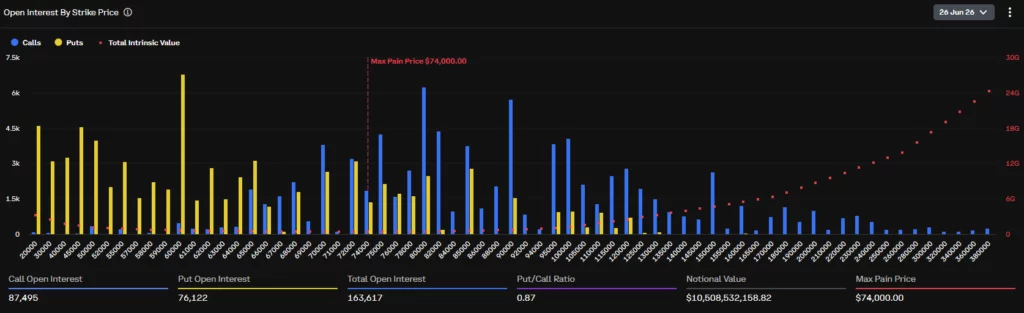
Call open interest is concentrated around the $80,000 strike, while put demand is strongest near lower strike levels, including $60,000. The max pain price currently sits at $74,000, substantially above Bitcoin’s current market price.
Bitcoin’s decline below $65,000 has left a large share of bullish contracts out of the money, increasing the likelihood of dealer hedging activity and heightened volatility as traders reposition ahead of settlement.
Bitcoin remains trapped inside a vulnerable recovery structure
The four-hour chart shows Bitcoin testing the lower boundary of an ascending channel that has guided price action since the June 5 rebound from the $60,000 area.
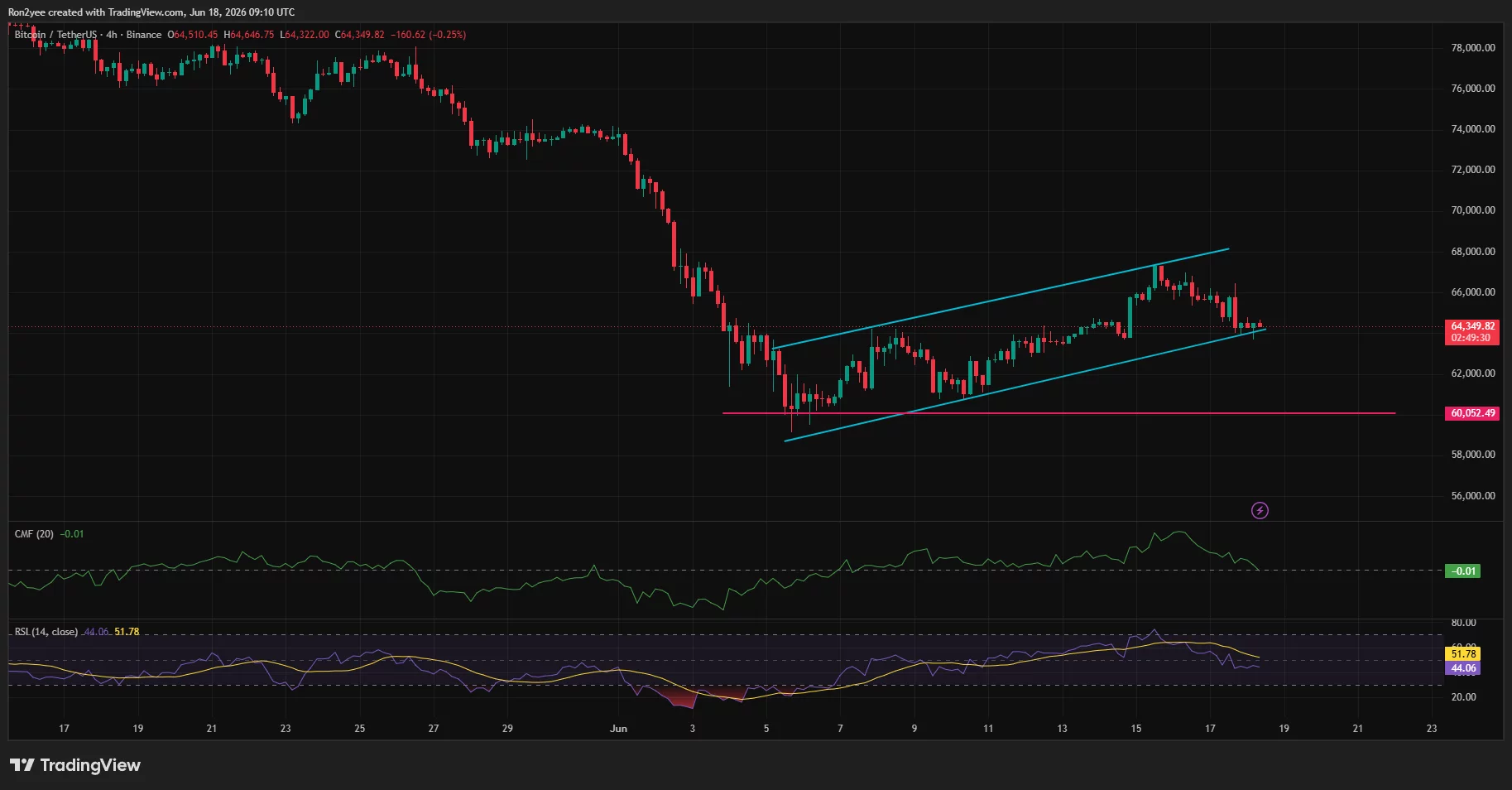
Buyers defended the channel several times during the past two weeks, but the latest rejection from the upper trendline near $67,000 has pushed BTC back toward a critical support zone around $64,000.
Momentum indicators have weakened alongside the pullback. The Relative Strength Index has slipped toward neutral territory near 44, while Chaikin Money Flow has fallen back toward zero after briefly turning positive during last week’s rally. Those readings suggest buying pressure has cooled following the Fed-driven reversal.
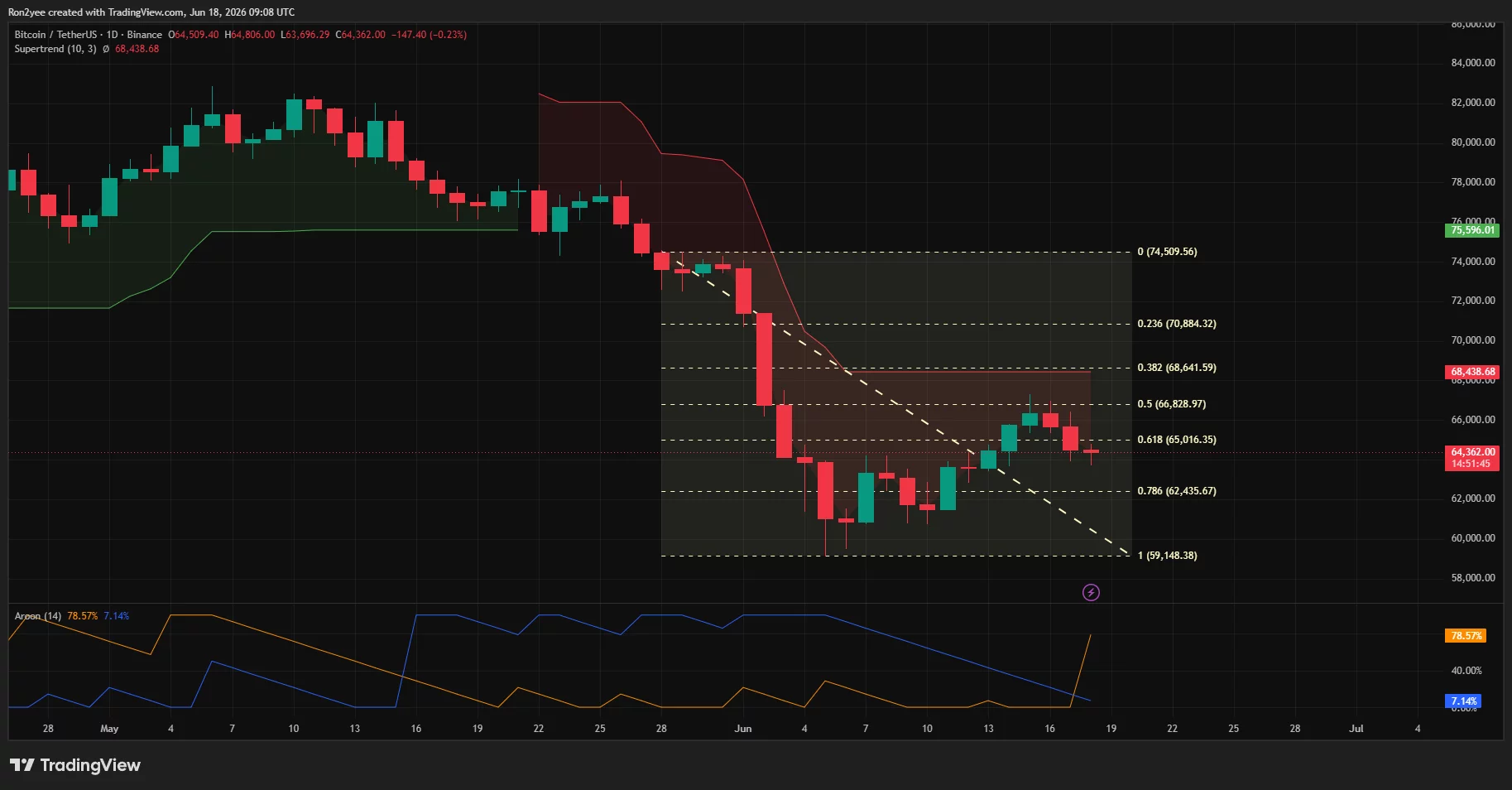
The daily chart presents another obstacle for bulls. Bitcoin failed to reclaim the 61.8% Fibonacci retracement level near $65,000 and remains below the daily Supertrend resistance around $68,400. The Aroon indicator continues to favor sellers, with Aroon Down holding above 78% while Aroon Up remains near 7%, highlighting that the larger downtrend from May’s highs remains intact.
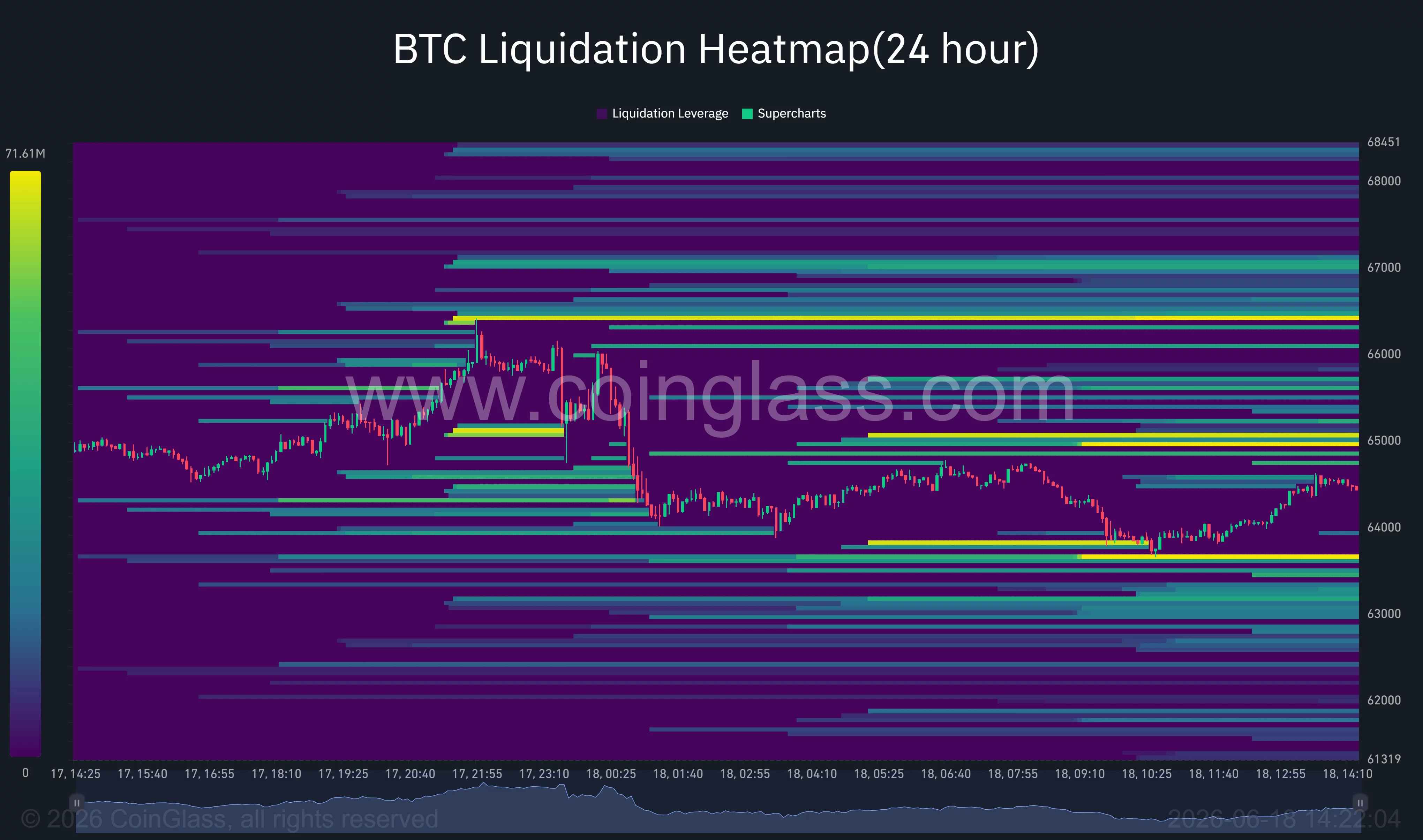
Liquidation data also identifies several important battlegrounds. CoinGlass heatmaps show dense liquidity clusters concentrated near $65,000, $66,300 and $67,000 overhead, while sizeable liquidation pools sit near $63,500 and $62,000 below current prices. Markets often gravitate toward these zones when leverage builds, increasing the probability of sharp directional moves.
Commenting on the current setup, analyst Ted Pillows noted that Bitcoin had successfully retested the $64,000 support zone following the Fed’s latest policy meeting, but warned that buyers must defend the level to keep the recovery intact.
“$BTC tapped the $64,000 support zone after yesterday’s FOMC meeting. This level needs to hold for any rally towards $67,000-$68,000. Or else, Bitcoin will drop towards $61,000-$62,000 again.”
Bears could target $60K if macro pressure intensifies
Institutional demand still remains another challenge for Bitcoin. U.S.- listed spot Bitcoin ETFs have recorded persistent outflows in recent weeks, while the Coinbase Premium Index has remained in negative territory, suggesting weaker buying activity from U.S.-based investors and large market participants.
Additional caution comes from on-chain analysts tracking Bitcoin’s realized price. According to analyst Draxen, previous market cycles often saw BTC trade below the realized price during major bottoming phases.
Draxen argued that “a visit to the $50K region remains a possibility before BTC establishes enough strength for a convincing break and hold above $100K.”
For bulls, reclaiming $65,000 and then breaking above the $67,000-$68,000 resistance cluster would weaken the immediate bearish structure and expose the June high near $66,800 before a potential move toward $70,000.
Failure to defend the ascending channel, however, could shift attention back to $62,000 and the June swing low near $60,000, particularly if Treasury yields continue rising and the Fed maintains its higher-for-longer stance.
Disclosure: This article does not represent investment advice. The content and materials featured on this page are for educational purposes only.
