


Ripple announced strategic investments in two UK-based firms, Zilo and Licuido, on August 3, 2026, converting existing commercial partnerships into equity positions and adding regulated transfer agency, digital issuance, and collateral mobility to its capital markets infrastructure on the XRP Ledger.
The investments address the gap that has kept most institutional tokenization projects in pilot mode: a tokenized fund share is only useful when it can be financed, pledged as collateral, and settled against cash with legal certainty, capabilities that require regulated ownership records, compliant issuance rails, and atomic delivery-versus-payment settlement, precisely what Zilo and Licuido supply.
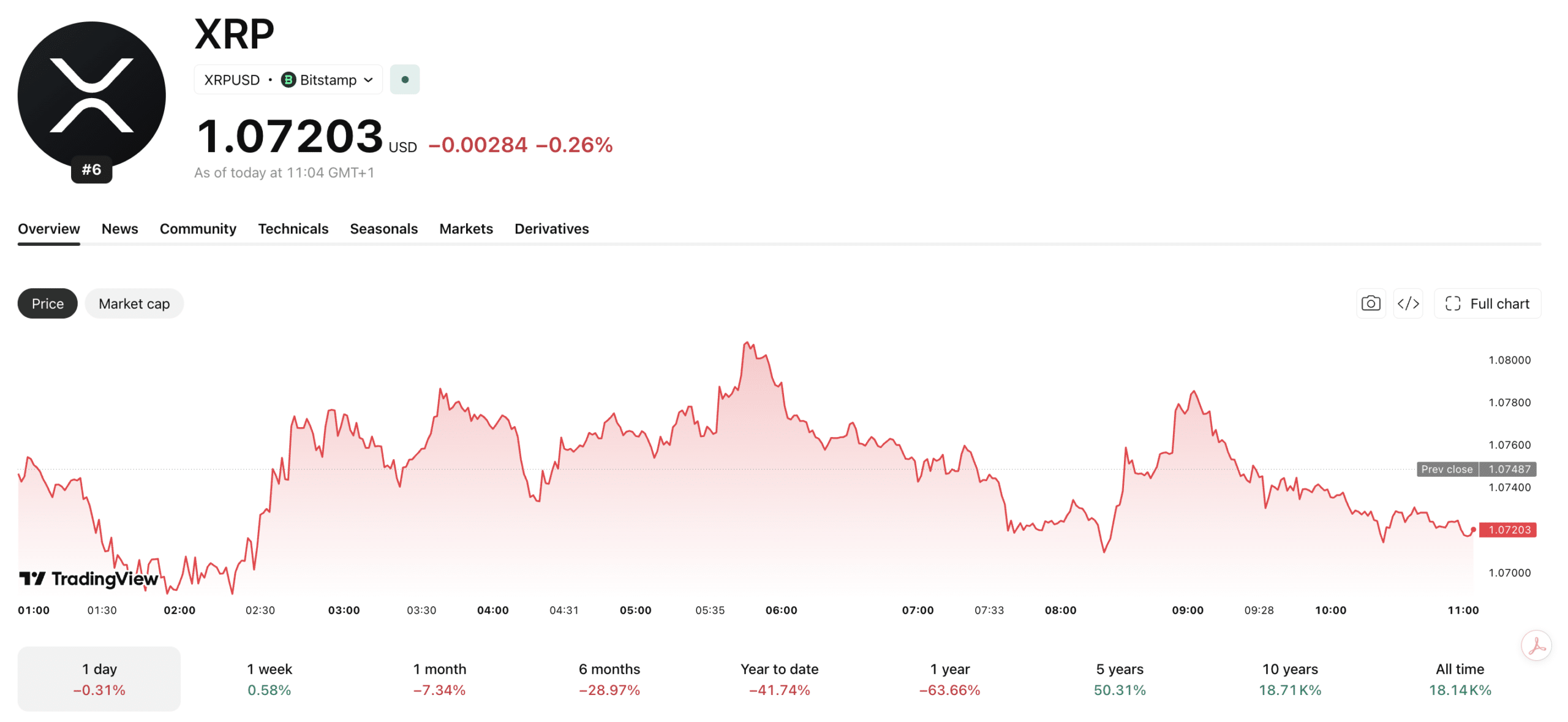
This news dropped as XRP USD trades for $1.07, up around +0.5% over the past 24 hours. This continues its modest run over the past seven days, with the token up +1.7% in the past week. Daily trading volume sits at $965M.
#StateStreet #XRPL A $57.9 trillion custodian backed a small transfer agency startup in 2024. Today that startup just became Ripple’s newest bridge into TradFi.
ZILO the platform State Street uses for its UK transfer agency business just launched a Digital Transfer Agency built… https://t.co/FCM7SnfNEX pic.twitter.com/keEV2doYvE— 𝗕𝗮𝗻𝗸XRP (@BankXRP) August 3, 2026
Zilo and Licuido: What Each Layer Does on XRPL
Zilo provides the transfer agency and fund administration layer – the regulated record of who owns which tokenized share class – that is the prerequisite for any lender or counterparty to extend credit against a fund holding.
Licuido, which is Financial Conduct Authority (FCA)-regulated, handles issuance, distribution, execution, and collateral mobility, enabling tokenized assets to circulate through on-chain markets rather than sit idle on balance sheets.
Ripple’s dollar-pegged stablecoin RLUSD serves as the cash leg for delivery-versus-payment transactions, so that transfer of a tokenized asset and its corresponding payment settle simultaneously on the XRPL, typically within seconds.
The combined stack, regulated ownership records from Zilo, issuance and liquidity from Licuido, and RLUSD for settlement is designed to close the full tokenized-asset lifecycle on a single ledger.
DISCOVER: Best Meme Coins to Buy in 2026
Aviva Investors and the Institutional Precedent Already in Production from Ripple
Deepening our push into capital markets, we are investing in ZILO and Licuido to add regulated transfer agency, issuance and collateral mobility to our capital markets infrastructure built on the XRPL. This comes on the heels of Aviva Investors tokenising its US Dollar Liquidity…
— Ripple (@Ripple) August 3, 2026
The investments are not speculative bets on unproven vendors. Licuido was already the tokenization infrastructure provider in the Aviva Investors USD Liquidity Fund deployment on XRPL, which went live on July 29, 2026, the first tokenized fund structure approved by the Central Bank of Ireland on a public blockchain. Ripple is, in effect, taking equity in infrastructure it has already put into production.
That deployment sits within a broader institutional build-out. In February 2026, Ripple announced a partnership with Aviva Investors, which manages $345Bn in net assets as of 2025, to tokenize fund structures on XRPL.
A separate memorandum of understanding with DBS and Franklin Templeton outlined a path for the sgBENJI tokenized money market fund to serve as repo collateral on DBS Digital Exchange alongside RLUSD, establishing the same collateral-mobility thesis these new investments are designed to industrialize at scale.
Ripple’s Institutional Tokenization Positioning: The Analytical Question
Nigel Khakoo, Ripple’s senior vice president for trading and markets, highlighted that tokenization is just the beginning, as its true value comes from trading, settling, borrowing, lending, and posting margin.
He cited Ripple’s collaboration with asset managers to demonstrate the deployment of tokenized fund structures at scale. Zilo and Licuido are key players providing infrastructure and liquidity for this transformation.
The focus has shifted from the ability to mint tokenized assets on XRPL, proven by Aviva and Franklin Templeton, to whether these assets can achieve genuine secondary liquidity and serve as financeable collateral at institutional levels. The next 12 to 24 months will reveal if these structures can create active liquidity or remain dormant.
Additionally, Ripple is part of a UK government task force with 54 firms, including major players like Circle, BlackRock, and J.P. Morgan, working on live tokenized repo use cases within the year.
Meanwhile, XRPL is set to release its major upgrade, xrpld 3.3.0, next week, which aims to enhance tokenization and institutional finance capabilities.
EXPLORE: Best Meme Coins to Buy for August
Disclaimer: Coinspeaker is committed to providing unbiased and transparent reporting. This article aims to deliver accurate and timely information but should not be taken as financial or investment advice. Since market conditions can change rapidly, we encourage you to verify information on your own and consult with a professional before making any decisions based on this content.

Daniel Frances is a technical writer and Web3 educator specializing in macroeconomics and DeFi mechanics. A crypto native since 2017, Daniel leverages his background in on-chain analytics to author evidence-based reports and deep-dive guides. He holds certifications from The Blockchain Council, and is dedicated to providing “information gain” that cuts through market hype to find real-world blockchain utility.
