


The Chainflip exploit on Saturday moved about $4.86 million out of the cross-chain swap protocol’s Ethereum vault in a single transaction that carried a valid signature.
Ethereum blockchain records show the transfer at 07:10:59 UTC on November 21. It took 520.22 ETH, 3,249,631 USDC and 758,141 USDT in one batch.
Roughly two hours later, Chainflip said it was putting the whole protocol into “full safe mode,” with deposits, withdrawals, swaps and quoting switched off.
For anyone who uses Chainflip to move native Bitcoin across chains, the pause matters right away. So does the question of how a signed transfer emptied the vault.
What the Blockchain Shows About the Chainflip Exploit
We traced the transaction ourselves, using the vault address Chainflip lists in its mainnet documentation.
The call was a “transferBatch” request sent to the vault from a brand-new wallet. That wallet had received about 0.99 ETH from Tornado Cash’s 1 ETH pool exactly one minute earlier.
Under Chainflip’s design, the vault releases funds only when a signature checks out against the aggregate key stored in its KeyManager contract. The transaction passed that check.
At an ETH price of about $1,637, according to CoinGecko, the batch was worth roughly $4.86 million. Stablecoins made up about 82% of it.
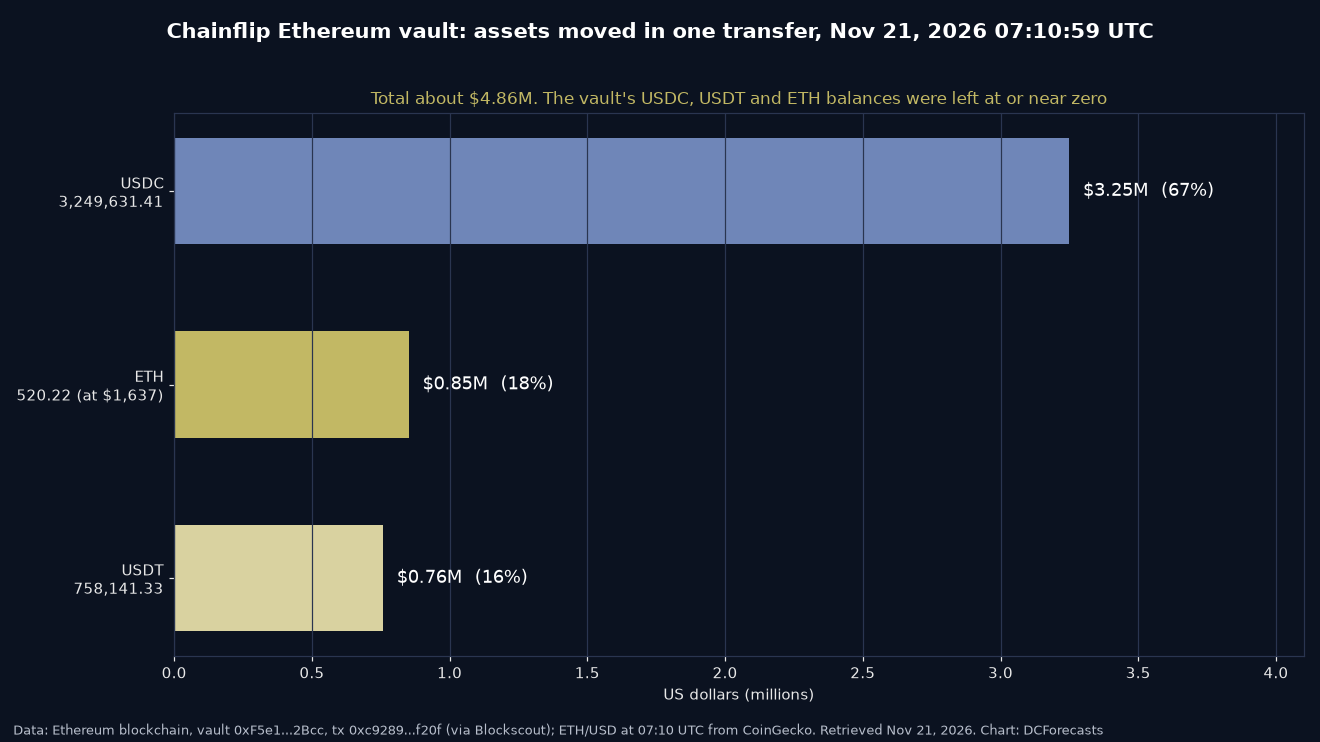
Our reconstruction of the vault’s transfer history shows the batch took its entire USDC and USDT balance, and its ETH balance fell to almost nothing.

ADVERTISEMENT
In other words, this was not a partial leak. Whoever signed it knew exactly what the vault held.
Eight Minutes From Vault to Mixer
The laundering that followed was fast and methodical.
At 07:12:59 UTC, the receiving wallet swapped the USDC for about 1,910 ETH through Uniswap’s router. The USDT followed at 07:14:23, bringing in about 457 ETH.
Converting stablecoins first was the logical move for an attacker. Tether and Circle can freeze their tokens, while ETH has no issuer to step in.
A second wallet then sent 2,909 ETH into Tornado Cash in three batches between 07:18:23 and 07:19:11 UTC, mostly in 100 ETH deposits.
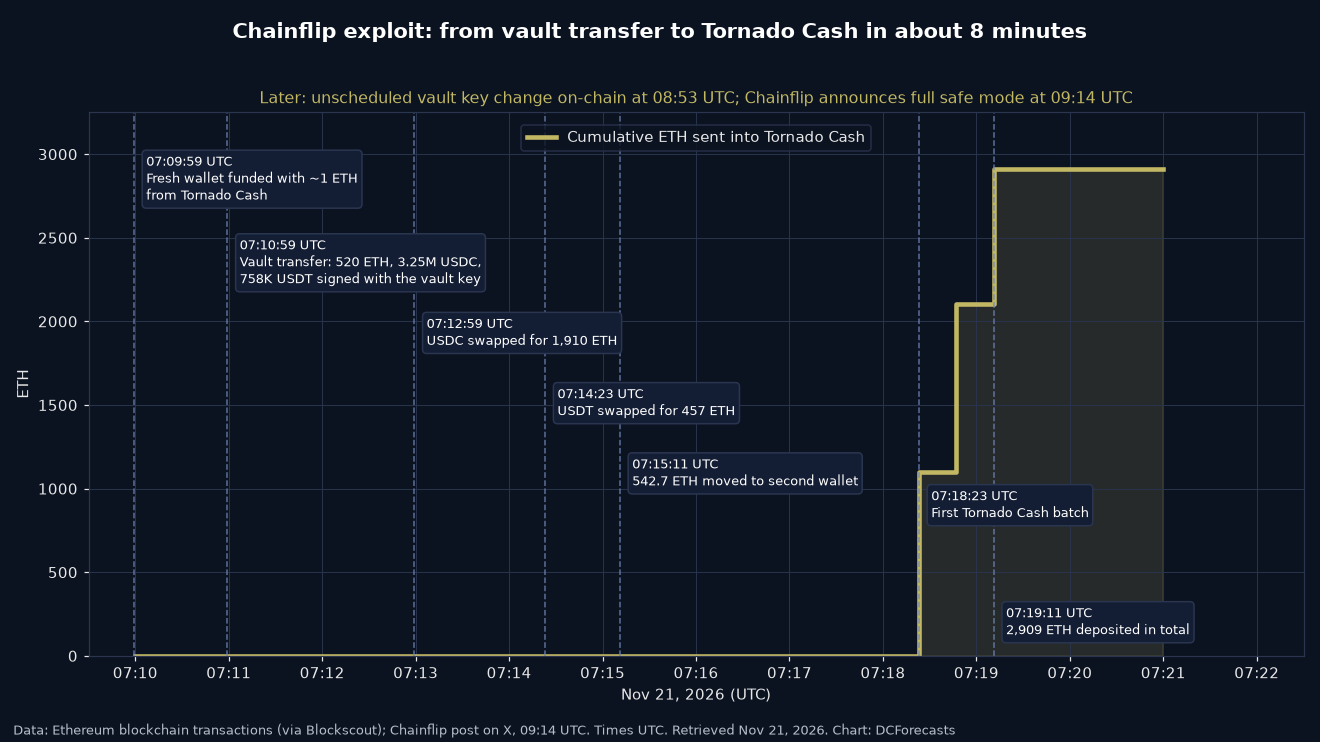
That is just over eight minutes from drain to mixer. We see the same playbook that hit Gonka’s Ethereum bridge earlier this week, where control of a signing key was also the whole game.
Why Did Chainflip Take Two Hours to Pause?
The vault did not stop working after the drain. On-chain data shows it kept processing routine-looking withdrawal batches and receiving new deposits until about 08:17 UTC.
At 08:53 UTC, a “setAggKeyWithAggKey” call updated the vault’s aggregate key. Chainflip’s documentation says payloads signed with the previous key stop being valid once that happens.
The timing stands out. Every key rotation we found from October 31 to November 18 landed between about 20:40 and 21:55 UTC, roughly three days apart. This one came off that schedule.
Chainflip’s public notice followed at 09:14 UTC. “We’re aware of a potential exploit affecting Chainflip vaults,” the team wrote on X, adding that it was “investigating and will share updates.”
The project has not yet said how the signature was produced or whether any vault beyond Ethereum was affected. Until it does, we would treat any single explanation as unconfirmed.
What It Means for Native Bitcoin Swaps
Chainflip’s pitch is swapping native assets, including real BTC, without wrapped tokens. Just a day earlier, the team promoted a $291,000 swap into Bitcoin made through a Trezor wallet.
Full safe mode freezes that route along with everything else. Users with swaps in flight will need to wait for Chainflip’s next update.
The on-chain record we reviewed covers the Ethereum vault only. Nothing in it touches the Bitcoin network, which kept producing blocks as normal.
We believe that distinction is the real lesson. Bitcoin’s own rules did not fail here. The risk sat in an off-chain key arrangement shared by Chainflip’s validators, which its documentation puts at 150.
Hacked bridges, vaults and exchanges keep showing why simple self-custody matters. As we noted with the Binance hack launderers now mixing stolen BTC, the weak link is almost always the intermediary.
What We Are Watching Next
The first signal is Chainflip’s post-mortem. A stolen key share, a signing bug or a software flaw would each call for a very different fix.
The second is recovery. Most of the money is now in Tornado Cash, which makes clawbacks hard, though withdrawals can still be tracked when they appear.
The third is the restart plan, including how users and liquidity providers are made whole and when native BTC swaps return.
For Bitcoin holders, the takeaway is reassuring. The base layer held firm, and keeping BTC in your own custody avoids this kind of single-key failure entirely.
The coming days will show whether Chainflip can explain the signature quickly enough to win back the users who relied on it for cross-chain swaps.
DC Forecasts is a leader in many crypto news categories, striving for the highest journalistic standards and abiding by a strict set of editorial policies. If you are interested to offer your expertise or contribute to our news website, feel free to contact us at [email protected]
