


The Ethereum Foundation has doubled the size of its protocol security team and made one upgrade its top priority: moving Ethereum off elliptic-curve cryptography before quantum computers or AI can threaten it.
The plan was laid out in a Nov. 23 post on the foundation’s blog, the first in a new series called PQAI, short for post-quantum and post-AI.
The timeline is tight. Researcher Justin Drake put forward December 2028 as a target at Devcon in Mumbai, while the foundation’s internal deadline is 2029, with a review of that schedule planned for January.
For crypto investors, the bigger story is the trade-off. The foundation openly says features developers have worked on for years will have to wait.
The question now is whether Ethereum can pull off a migration it calls harder than the Merge, on less time.
What the Ethereum Foundation Announced
The post, written by Kev Wedderburn, describes three pieces of work.
First, validators would sign with hash-based keys, so finality no longer depends on elliptic curves. Second, wallets would give users a straightforward path to hash-based signatures. Third, blobs, the data packets rollups post to Ethereum, would switch to hash-based commitments.
The foundation said it spent more than a year evaluating candidate signature schemes before backing hash-based cryptography.
Its reasoning is simple. Ethereum already depends on hash functions being secure, so the switch “does not add a new assumption.”

ADVERTISEMENT
Early specifications have started, and developers are already iterating on a first post-quantum consensus-layer devnet.
Why AI Moved Post-Quantum Cryptography Up the List
Quantum computers have long been the threat in this debate. The foundation’s post says AI has now “emerged as a more urgent risk.”
It points out that AI models are already finding bugs in production software faster than people can review them, including thousands in the Linux kernel.
The foundation does not claim AI can break today’s cryptography. It argues that relying on more conservative assumptions now is prudent risk management, rather than waiting for the tools to improve.
We think that framing matters. It turns post-quantum cryptography from a distant research topic into a near-term engineering deadline.
Moving fast also creates risk, which explains the staffing decision. The foundation wrote that formal verification and security work must keep pace with protocol development, and that “cutting corners here would defeat the whole purpose of the upgrade.”
The Cost: Bigger Signatures and Delayed Features
Size is the hardest constraint. A standard elliptic-curve signature on a 256-bit curve takes 64 bytes.
The post-quantum signature standards NIST finalized are far larger. The lattice-based ML-DSA ranges from 2,420 to 4,627 bytes, while hash-based SLH-DSA under FIPS 205 runs from 7,856 to 49,856 bytes.
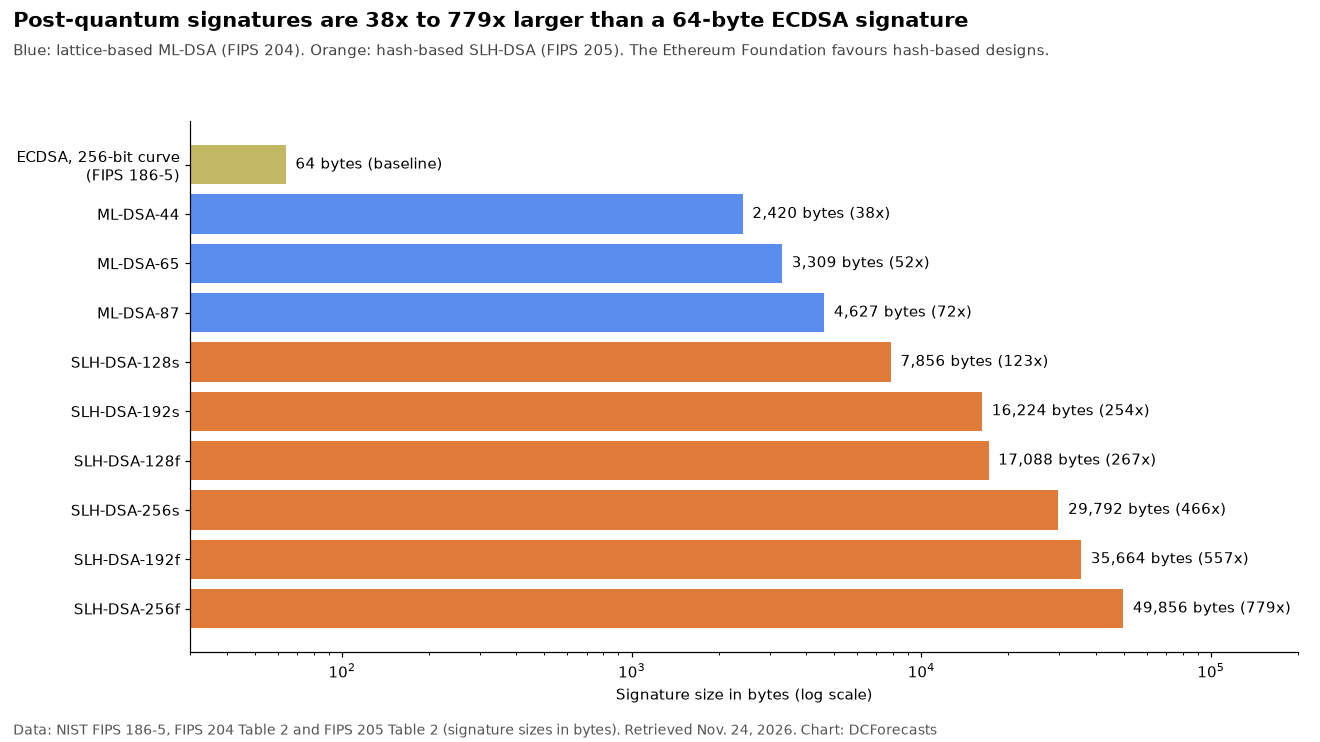
Those standard sets are 38 to 779 times bigger than today’s signatures. Ethereum’s final design may use its own parameters, but the direction is clear.
The foundation acknowledged the knock-on effects. Tooling built around BLS signatures needs reworking, contracts that assume pre-quantum cryptography need updates, and wallets, multisigs and staking pools all need changes.
It also plans to watch hardware requirements closely so people can still run nodes at home.
Development is already being reshuffled. Ethlabs pulled its Quick Slots proposal out of the Hegotá upgrade to free engineering time, and remaining core-developer calls this year will discuss which other features to drop.
That comes on top of an already crowded schedule. As we reported, Ethereum’s Glamsterdam upgrade slipped into 2027 after an audit flagged 200 findings tied to its gas changes.
How the Ethereum Foundation Deadline Compares With NIST
The foundation’s 2028 to 2029 window sits well ahead of the U.S. government’s own schedule.
NIST’s draft transition guidance, Internal Report 8547, would deprecate ECDSA at the 112-bit security level after 2030 and disallow ECDSA after 2035.
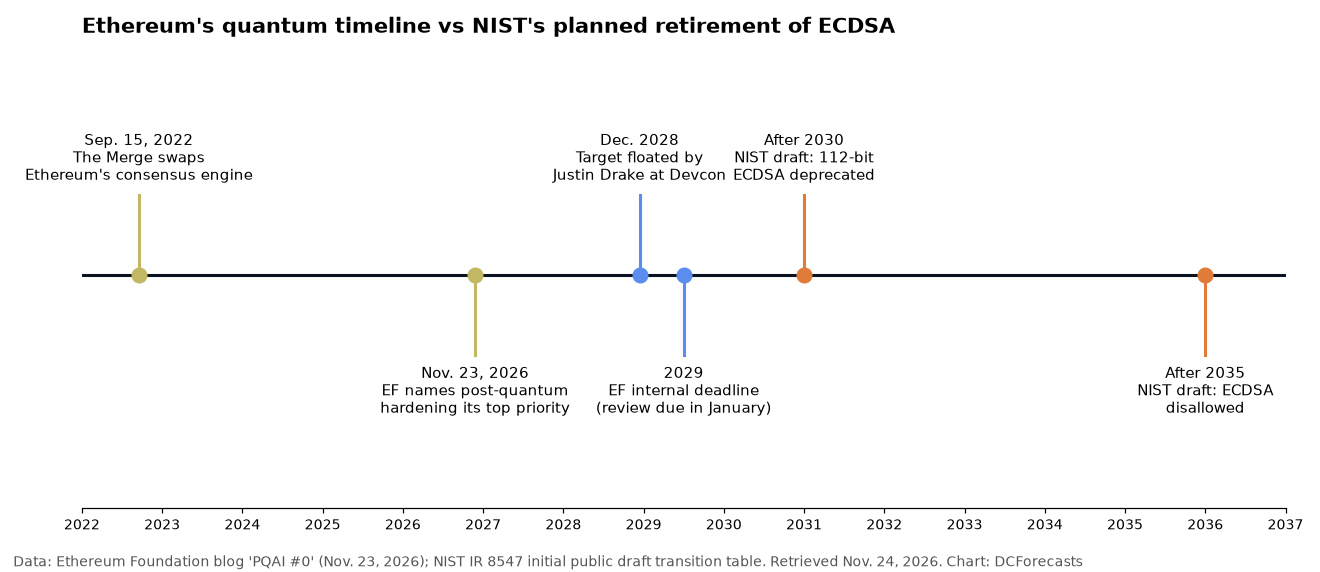
The foundation is leaning on its track record. On Sept. 15, 2022, Ethereum replaced its consensus engine during the Merge while the chain stayed live, with no downtime and no lost funds.
It admits this time is different. “This upgrade is harder than the Merge, and we have less time,” the post reads.
We believe the honest tone is a strength. Naming the costs up front gives wallet teams, stakers and rollups time to prepare.
What It Means for Bitcoin and the Ethereum Roadmap
Bitcoin faces the same long-term question, and its developers are working on it in their own conservative way.
The SHRINCS proposal, which we covered when it received a 131-page security analysis, is also built on hash functions, with SHA-256 at its core. That is the same hash function behind Bitcoin’s proof-of-work.
The shared conclusion is encouraging. Two of the largest blockchains are converging on hash-based security, which has been battle-tested for decades, rather than newer mathematical bets.
For quantum computing and Bitcoin, we see the debate as a sign of maturity rather than fear. Networks that plan years ahead of the threat are the ones institutions can trust with long-term savings.
Markets were quiet on the news. Ether traded near $1,698 and Bitcoin near $60,369 on Tuesday morning, both down less than 2% over 24 hours, according to CoinGecko data.
The foundation summed up its goal as building for someone who wants to pass a key to their great-grandchildren “without worrying whether the cryptography will break.”
That is the same promise long-term Bitcoin holders care about most. The coming months of devnets and developer calls will show how quickly Ethereum can turn that goal into code, and how much of its roadmap it is willing to set aside to get there.
DC Forecasts is a leader in many crypto news categories, striving for the highest journalistic standards and abiding by a strict set of editorial policies. If you are interested to offer your expertise or contribute to our news website, feel free to contact us at [email protected]
